
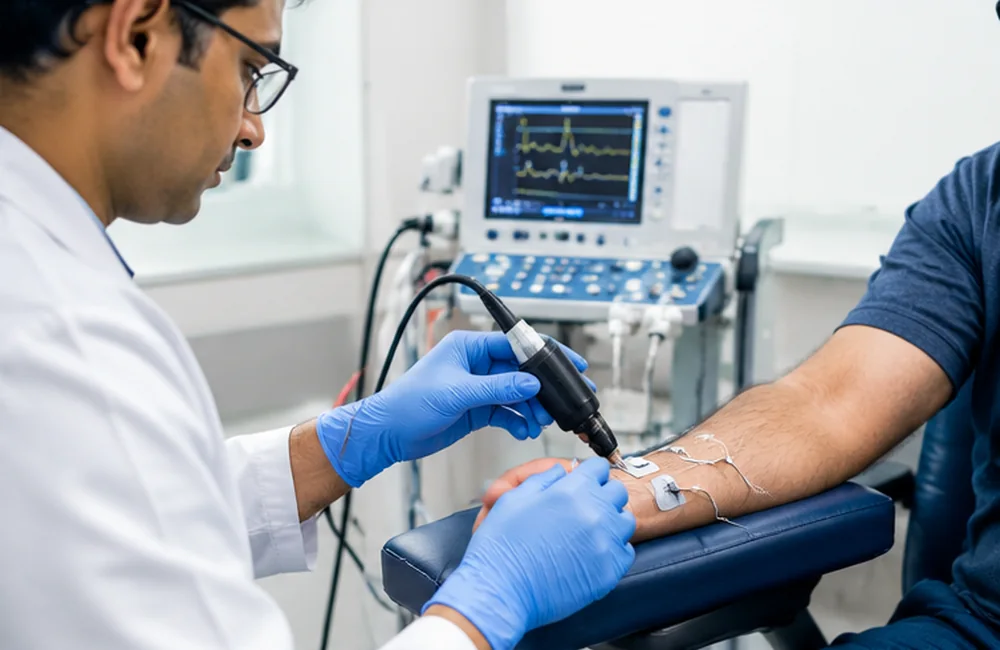
Why your doctor may advise this test
To investigate unusual muscle weakness or twitching.
To explore whether symptoms may be linked to nerve or muscle changes.
To add information to a neurological examination.
What happens during the test
The specialist explains which muscles need to be tested.
A very fine needle sensor may be placed into selected muscles.
Signals are recorded as you relax and gently move the muscle.
How to prepare
Tell the specialist if you take blood-thinning medicine.
Mention bleeding conditions, implanted devices and infections near the area.
Wear clothing that makes the area easy to reach.
Understanding your result
An EMG helps a specialist understand muscle and nerve function. It is usually interpreted together with your examination and sometimes a nerve conduction study.
Ready to book?
Book this test with Lakhotia Diagnostics
Our team can help you confirm preparation rules, the most suitable centre, appointment timing and whether home collection is available for your test.
Frequently asked questions
Does an EMG test hurt?+
You may feel brief discomfort when the small needle sensor is placed.
Is it a blood test?+
No. The needle is a sensor that records muscle activity; it is not used to take blood.
Will I have marks afterwards?+
Mild soreness or a small bruise can happen around a tested muscle.
Is EMG always done with NCV?+
Not always. Your clinician decides whether one or both are needed.